
This is for you if you want to understand your “human operating system” or “personality DNA”, namely, how human beings behave and what causes them to behave that way.
You want to understand the following:
- Why do I behave the way I do?
- What creates the uniqueness of each human being?
- How is it that others see the world so differently from me?
- What stops me from being pro-active even when they know what to do?
- What causes dysfunction in relationships?
- What drives me to be confrontational and antagonistic?
- What stops me from reaching our full human potential?
- How can I have the most productive conversations?
How does it work, and what do I get, how much does it cost?
- The assessment is taken online – you will receive a link from me and can complete the questionnaire
in your own time. It takes about 40 minutes. - What you will get:
1) Ennea Five Lens Report (Option 1. Standard 24 pages, Option 2. Premium 43 pages)
90–120-minute Personal Debrief (Zoom, or face-to-face)
2) Five Lens Summary Graphic - Prices: on request but between R 2000 and R2 750 (depending on option/package).
You can benefit even more if you UPGRADE to Follow-Up Coaching Package where you get three
sessions at a discounted rate.
The Ennea 5 Lens Report will deliver the foundations to explore questions for you as an individual and as team.
The Ennea 5 Lens Report has been developed by Ennea International (www. Enneainternational.com).
We focus on 5 areas of your personality. It is like looking at you through 5 different lenses or taking 5 snapshots of you.
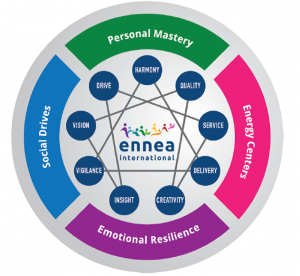
The 5 lenses are:
1. The Enneagram
2. The six Personal Mastery factors
3. Emotional Resilience
4. The three Social Drives (Survival, Achievement, Affiliation) and Transcendence
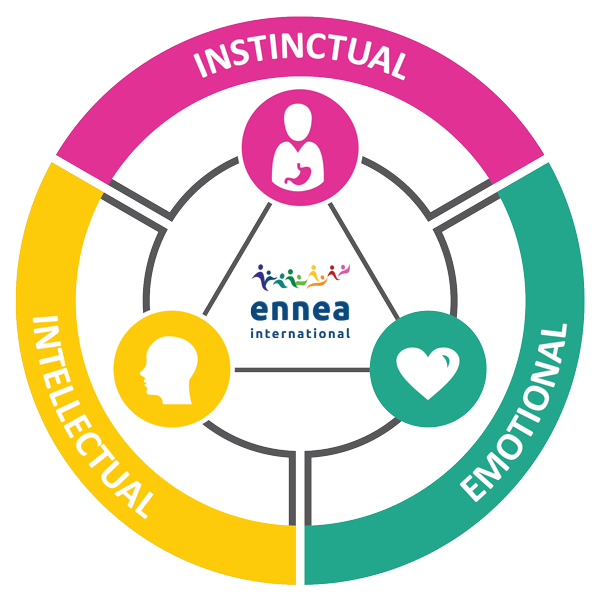
5. The three Energy Centres (Intellectual, Emotional, Instinctual)
The Ennea 5 Lens Report has been developed by Ennea International Group
Value/Benefit for you as an individual:
• Deepening personal awareness about current patterns of behaviour
• Clarify your areas of strengths
• Identify development areas
• Confront your key avoidance strategies
• Provide a resource for significant increase of your conversational intelligence
• Stimulates personal growth
Value/Benefit for the team:
• Promote team effectiveness
• Develop and sustain high performance winning teams
• Create quality leadership
• Advance effective working relationships
• Elevate conversations in the context of conflict, feedback, collaboration and thinking partnerships
• Build capabilities needed for the future world of work
• Boost resilience and trust
Learnings and developments are deepened by personal and/or team coaching, high performance team development days and modules so that you can quickly experience a positive difference.
Lens 1 – The Enneagram
The Enneagram
which gives insight into how we experience, react to, and show up in the world
The Enneagram describes nine “Ways of Being” or patterns of behaviour that are recognised in people from diverse cultures throughout the world. Out of habit, past experience, and even inherited qualities, individuals tend to use one of these patterns more frequently than the other eight.

Each of the nine encapsulates certain:
• Motivational drives
• Core areas of avoidance
• Defence mechanisms
• Values, likes & dislikes
• Preferred ways of learning
• Habits related to language, thought, perception, sensemaking, verbal communication
• Habits of emotional experience and reactivity
• Habits related to the body and action
Our dominant Enneagram style powerfully affects the way we interpret events and people and sensitizes us to specific circumstances and conditions. Having said that, each of us has access to all nine Enneagram styles which we use either more or less frequently depending partly on how “fixated”, or stuck, we are in our dominant style, and also on the context that we find ourselves in.
Note: The Greek word “ennea” means “nine”, “gram” means “that which is drawn” -> Enneagram = “picture of nine”
Lens 2 – Personal Mastery
Personal Mastery
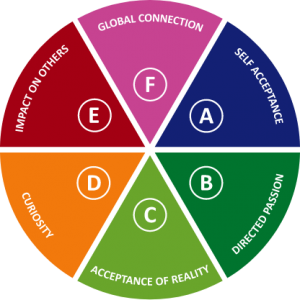
which comprises of six sub-factors
Personal Mastery contributes towards emotional maturity and resilience. People with high Personal Mastery are likely to cope with life in a mature way, make conscious choices and overcome difficulties with relative ease. They are aware of their growth areas and developmental gaps.
High Personal Mastery is linked to a life of continual learning and not something you possess. Personal Mastery goes beyond competence and skill – it involves a creative solution oriented mind-set to facility the results an individual seeks in life.
In combination, the six Personal Mastery factors provide an overall view indicating the degree to which an individual has progressed on this personal journey.
Note: The Personal Mastery Scale is indirectly derived from Peter Senge’s work.
Lens 3 – Emotional Resilence
Emotional Resilence
which has a relationship to levels of stress
Emotional Resilience is the ability to cope with, and to recover from, stressful situations, adversity and crises – simply put: the ability to bounce back!
Emotional Resilience levels are affected by experiencing either a major stressful event or a number of stressors over a certain period of time, even if these individual stressors are relatively minor.
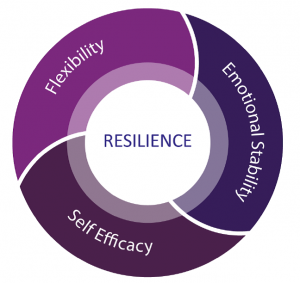
The three dimensions of resilience are:
FLEXIBILITY a Mental-Intellectual characteristic. The ability to adapt and focus the attention on positive outcomes.
EMOTIONAL STABILITY an Affective-Emotional attribute. The ability to act in a rational mannr in stress situations without becoming overly anxious or angry.
SELF-EFFICACY a Directional-Motivational aspect. The ability to take on challenges, learn new things and belief in one’s capabilities.
Emotional resilience includes the ability to balance negative thought patterns and emotions with positive ones and to maintain an optimistic and “can do” attitude.
Research has shown that Emotional Resilience can be learned.
Note: Personal Mastery and Emotional Resilience determine the level of “Emotional Integration” which is a useful indication of an individual’s level of personal and interpersonal effectiveness
Lens 4 – Social Drives
Social Drives
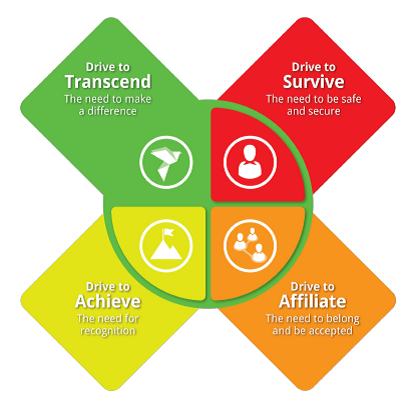
which relates to three social instincts and the drive to transcend
Social drives point to where an individual focuses his or her attention. “What matters most”? What do individuals strive to obtain?
The Drive to Achieve (Social instinct) – The drive to seek excellence, recognition, status, personal value and worth.
The Drive to Affiliate (Relationship instinct) – The drive to be accepted and included in a social group.
The Drive to Survive (Self-preservation instinct) – The drive to secure physical safety and sustained satisfaction in terms of food, shelter, health.
The Drive to Transcend (Transformation) – The drive to search for a higher purpose in life extending beyond self.
Lens 5 – Energy Centres
Energy Centres
which relates centres of human intelligence
Each centre points a modality for processing information and making decisions.
The three centres are:
Intellectual – The Head (mental, thinking)
The use of logic and reasoning in approaching the world and decision making.
Emotional – The Heart (feeling)
The use of feeling and emotional sensitivity in approaching the world and decision making.
Instinctual – The Body/Gut (physical)
The use of action and intuition in approaching the world and decision making.
The use of all three centres is required to be whole, integrated, aware, alive and centred. It seems to be part of the human experience to juggle these three centres:
“my head says one thing, my heart another, and my gut is saying something else”.